


Often disguised as patriotic slogans or innocuous buzzwords, dog whistles can activate the underlying fears or biases within the target audience without attracting broader public backlash. As overt appeals to racism or prejudice have become more politically risky, dog whistles have become a stealthier way to deliver controversial, divisive, or socially unacceptable messages without explicitly stating them. Their power lies not only in what they communicate, but also in what they leave unsaid.
Dog whistles work because people naturally interpret language through the lens of their existing beliefs, experiences, and assumptions. When a phrase is sufficiently vague or emotionally charged, different audiences project different meanings onto it, based largely on implicit bias - the unconscious tendency to form judgments about people or groups based on stereotypes or social conditioning rather than objective assessment.
and emotional reasoning - a cognitive distortion in which a person concludes that their emotional reaction to something reflects its objective reality.
, often gravitating toward meanings that feel familiar, intuitive, or consistent with their existing worldview.
In doing so, the audience is not simply receiving a message but actively participating in the construction of its meaning. Because that implied meaning is often inferred rather than stated, it can feel especially authentic to those who pick up on it. While one group may perceive only the literal surface meaning, others may hear an appeal to shared fears, grievances, or identities. What unites those responding to a dog whistle is not a shared understanding of the term itself, but a shared emotional reaction to it.
They also function as a form of social signaling - the process by which individuals display behaviors, choices, or traits to communicate their identity, values, or social status to others.
, allowing individuals to communicate affiliation with particular in-groups or shared causes. This signaling function taps into tribalism - a psychological mechanism in which people categorize themselves and others into groups, fostering loyalty and favoritism toward their ingroup while stereotyping or discriminating against outgroups.
and the human desire to be part of a larger group. The message therefore serves not only as communication, but also as a marker of belonging.
This creates a sense of shared understanding between the speaker and the targeted subgroup, allowing the speaker to mobilize and show alliance with certain audiences without openly embracing the rhetoric.
 Ku Klux Klan stages an 'America First' parade in Binghamton, NY. in the 1920's. (Getty Images)
This duality has long made dog whistles particularly useful when delivering racist or xenophobic messaging. In the 1920s, the slogan “America First” became associated with an isolationist movement that also attracted fascist sympathizers and anti-Semites. While the phrase appeared patriotic on the surface, it carried darker associations for a subset of the audience.
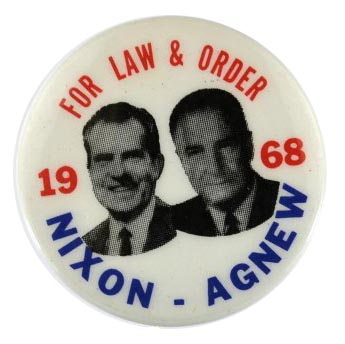
In the late 60s, calls for “law and order” activated fears among many white suburban voters about desegregation and changing racial dynamics, while maintaining a race-neutral appearance on the surface. These same two slogans - a brief, striking phrase designed to be memorable, evoke emotional appeal, and reinforce a specific message or idea.
would reemerge decades later in American political discourse, illustrating how dog whistles can be repurposed with similar results.

Dog whistles can also seem to emerge almost overnight in the form of new buzzwords. Contemporary terms such as "wokeness" or “critical race theory” often operate as symbolic shorthand for broader social and cultural anxieties. To some, they signal concerns about social change. To others, they function as coded references to race, culture, or perceived threats to traditional values. Their ambiguity allows them to activate different audiences even while many of the same people struggle to define exactly what they mean.
The same ambiguity that makes dog whistles effective is also what makes them difficult to unmask. Because the implied meaning is never stated outright, those who attempt to call them out can be dismissed as overly sensitive, paranoid, or unfairly projecting prejudice onto otherwise harmless statements. By doing so, dog whistlers can not only deflect scrutiny but portray themselves as victims of unfair attacks.
The plausible deniability built into dog whistles also creates an asymmetrical burden of proof. Because the controversial meaning is implied rather than explicitly stated, critics are forced to argue about interpretation, intent, symbolism, or historical context. This ambiguity can make accusations appear speculative even when the underlying signaling pattern is widely recognized by the intended audience.
Even worse, attempts to expose dog whistling can be turned against those calling it out. It is not uncommon for accusations of racist dog whistling to be met with counter-accusations of racism for "bringing race into the conversation." Criticism of the dog whistle can also become an opportunity to reinforce solidarity with the target audience, since not only the whistler, but those receiving the whistle can feel unfairly scrutinized by opponents. The controversy itself can strengthen that perception.
Recognizing dog whistles requires paying attention not only to what is explicitly stated, but also to what may be implicitly signaled to a particular audience.
Ask yourself: