


The effectiveness of rage farming lies in its ability to prey on impulsive, emotional reactions. By provoking anger, outrage, or indignation, it can amplify divisive content, intensify social conflicts, and draw large audiences into cycles of reaction and counter-reaction. People who engage with this content, whether supportive or critical, often become unwitting participants in its spread.
At its core, rage farming or "rage baiting" exploits the human tendency to react strongly to perceived threats or injustices. This reaction is driven by negativity bias - the psychological tendency to give greater weight to negative information or criticisms than positive or neutral messages, even when they are of equal intensity.
, the tendency to focus more on negative information than positive. Content that provokes anger, outrage, or indignation often attracts attention precisely because it feels consequential, controversial, or threatening.
Expressing anger on social media also tends to be rewarded algorithmically by generating more likes than other interactions. A single user expressing anger could start a chain reaction among other users, triggering a widening circle of hostility. This ripple effect is highly activating and can drive people to impulsively share rage farming content, becoming unwitting participants in its amplification.
Chinese researchers at Beihang University tracked different emotions embedded in millions of messages on a Twitter-like platform, and found that anger spread more quickly than any other emotion.  A social network (left) and that same network colored by spreading emotions:
Anger (red), joy (green), sadness (blue) and disgust (black).
Rage farming also taps into tribalism - a psychological mechanism in which people categorize themselves and others into groups, fostering loyalty and favoritism toward their ingroup while stereotyping or discriminating against outgroups.
, deepening in-group and out-group divisions as people sort themselves into opposing camps. Once a controversy captures attention, people rarely engage with it in isolation, instead seeing how friends, family members, political allies, influencers, and online communities are reacting. As individuals begin expressing outrage, support, or opposition, others may feel pressure to do the same. This dynamic is enhanced by conformity bias - the tendency for individuals to adopt the beliefs, behaviors, or decisions of a group to fit in, even when these conflict with their own beliefs or convictions.
, which encourages people to align themselves with the views of those around them to fit in with the group.
For those who feel a need to voice opposition, rage farming works there too, by creating an irresistible urge to set the record straight. As a result, rage farming content is often intentionally mistake-ridden or blatantly false, baiting skeptics to want to correct it. A single tweet based on a lie that goes viral can trigger a cascade of user activity - not just corrections and insults, but jokes, side debates, entire ecosystems that live on for a news cycle.
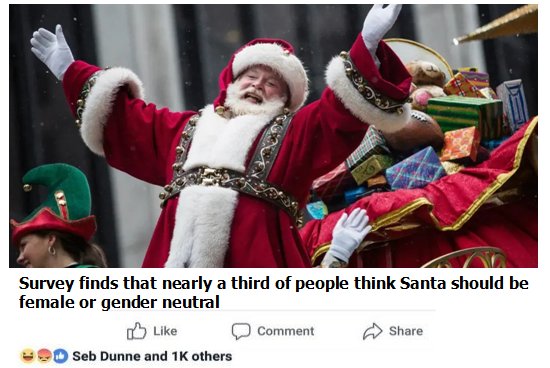
Rage farming involves creating controversies where none might otherwise exist. For instance, a post might misrepresent a complex issue in a way that vilifies one group while appealing to another, encouraging people on both sides to become emotionally invested in the controversy. To do this, rage farmers often seek out obscure or controversial opinions to amplify them to a larger audience as though they represent a broader cultural shift.
For example, at first glance, the social media post about reimagining Santa's gender appears to reveal a growing social movement to change one of the most recognizable figures in Western culture. Whether readers view that possibility positively or negatively, the suggestion that a familiar tradition is being altered can provoke strong emotional reaction and outrage, encouraging people to become emotionally invested in the controversy.
What is less apparent however is that the survey asked respondents "If you could 'rebrand' Santa for modern society, what gender would he be?" The answer choices provided were male, female, and gender neutral.
 The original survey question that sparked the controversy over Santa's gender.
So, the respondents were asked not if they wanted to "rebrand" Santa's gender, but rather how they would. The post demonstrates how easily a controversy can be manufactured by removing critical context and how the ensuing reactions can be exploited to drive engagement.
Just like a fire, rage farming needs certain key elements to ignite and keep burning. Every angry comment, share, or retweet, regardless of how well-intentioned or thoughtful, adds fuel to the fire. Understanding these dynamics can help people recognize when they are being drawn into a cycle that only benefits the rage baiter.
When an online post provokes a strong emotional response, ask yourself:
- Does the content appear to be designed to provoke outrage rather than inform?
- Is the controversy being presented with sufficient context or is context being left out?
- Is an obscure opinion being portrayed as something more widespread than it really is?
- Are you reacting to the issue itself, or to how it has been framed?