


Science denial should not be confused with ordinary scientific skepticism. While science advances through questioning, testing, and refining ideas, science denial advances through magnifying uncertainty, highlighting exceptions, and finding ways to dismiss contrary evidence. Rather than attempting to disprove an established scientific consensus outright using evidence, science denial often seeks to create enough uncertainty that the consensus itself appears unsettled or even controversial.
Science denial is not a single tactic but a collection of recurring techniques that work together to undermine public confidence in scientific consensus. These efforts, known collectively as FLICC, rarely aim to disprove the science outright; instead, they focus on creating the illusion of controversy where little or none exists.
Fake Experts: Also known as false authority, this tactic involves promoting individuals who appear authoritative but lack relevant expertise in the scientific field under discussion. This elevation of outlier voices presented alongside legitimate experts can create the impression that the scientific community is deeply divided when it may not be.
Logical Fallacies: Science denial also relies on other forms of flawed reasoning that make scientific findings appear weaker and more uncertain than they actually are. This typically includes the use of ad hominem attacks, straw man arguments, false equivalences, red herrings, false dichotomies, and slippery slope arguments.
Impossible Expectations: Science deniers often set unattainable standards for scientific evidence, demanding absolute certainty or perfection. They may dismiss findings that cannot provide 100% guarantees as unproven or meaningless. This exploits the public’s misunderstanding of how science works, where uncertainty and ongoing refinement are a natural part of the scientific process.
Cherry Picking: Rather than evaluating the full body of evidence, science denial often focuses on isolated studies, outliers, or anomalies that appear to contradict the broader consensus. By emphasizing exceptions while ignoring the larger pattern of evidence, well-supported conclusions can be made to seem far less certain than they are.
Conspiracy Theories: When scientific evidence becomes too difficult to dismiss using other tactics, deniers can turn to conspiracy theories to portray scientists, universities, governments, or other institutions as "all being in on it."
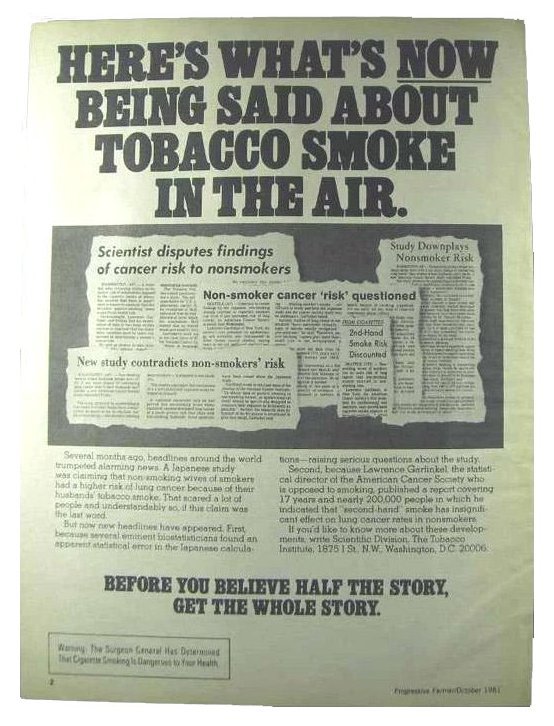 Tobacco industry ad on secondhand smoke from 1981.
FLICC tactics are effective because they exploit the complexity of science, operating on the assumption that most people lack the expertise to critically evaluate competing claims. By creating doubt and confusion, these tactics provide a rationale for skepticism, inaction, or outright rejection of scientific findings.
In the 1950s, the tobacco industry famously used these same tactics to fabricate a sense of scientific controversy around the connection between smoking and lung cancer that later proved to be both undeniable and deadly. By amplifying uncertainty and emphasizing the need for additional research, their strategy successfully created the impression that the science remained unresolved, helping delay regulatory measures for decades.
This same playbook can be seen employed today around issues supported by strong scientific consensus, like climate change and vaccines — amplifying dissenting voices, portraying settled questions as ongoing scientific debates, and framing it all within a global conspiracy. The objective is often less about disproving the science than leaving the public with just enough doubt to justify delaying action or doing nothing at all.
It’s not uncommon for beliefs stemming from science denial to persist long after the weakness of the arguments have been exposed. Once sufficient doubt has been instilled, parts of the narrative can be abandoned, revised, or replaced without necessarily changing the overall perception that the science remains unsettled.
Science denial can also be difficult to expose because it rarely asks audiences to reject science entirely. Instead, it often presents itself as healthy skepticism, open-mindedness, or a demand for additional evidence before taking action and disrupting the status quo - the cognitive tendency to prefer the current state of affairs and resist changes, even when those changes might be beneficial.
. This can make it difficult to distinguish legitimate scientific debate from efforts designed to simply cultivate uncertainty.
Even when misinformation is successfully corrected, the original claim may continued influencing - a cognitive phenomenon where misinformation persists in people's minds and continues to influence their beliefs, even after they recognize it has been debunked.
how people interpret new information. Compounded by confirmation bias - the cognitive bias that leads individuals to favor information that confirms their existing beliefs while disregarding or discounting evidence that contradicts them.
, individuals who have accepted a particular narrative may continue viewing subsequent evidence through that lens, making science denial especially resistant to correction, even when the evidence is overwhelming. These challenges become even greater when scientific evidence conflicts with personal values, political beliefs, or group identities. This can create a cognitive dissonance - the mental discomfort experienced when we are confronted with evidence that contradicts our beliefs, values, or attitudes, prompting a motivation to reduce the inconsistency.
that is often more easily resolved by rejecting or rationalizing contradictory evidence than acknowledging a previous belief was mistaken.
Engaging with science deniers can be challenging, particularly when beliefs become connected to personal values, political identity, or distrust of institutions. Simply presenting facts may do little to change minds, but certain strategies can help foster more productive conversations and reduce the likelihood of further entrenching existing beliefs.
When engaging with a science denier: