


Rather than treating disagreement as a normal difference between competing points of view, demonization transforms the opposing side into a threatening “other” whose motives, values, or very presence may be portrayed as an existential threat to the broader community. It typically casts opponents as those who cannot be reasoned with, trusted, or safely accommodated, making harsh or extraordinary actions against them appear legitimate, necessary, or even morally justified.
Demonization exploits the human tendency to divide the social world into “us” and “them,” drawing heavily on tribalism - a psychological mechanism in which people categorize themselves and others into groups, fostering loyalty and favoritism toward their ingroup while stereotyping or discriminating against outgroups.
to strengthen identification with the in-group while casting opponents as a threatening or morally corrupted out-group. Ordinary differences in beliefs or values can become evidence that the opposing group is fundamentally unlike “us,” while portrayals of malicious intent can transform political or social disagreement into a perceived struggle between good and evil.
The emotional intensity of these portrayals can further shape judgment through emotional reasoning - a cognitive distortion in which a person concludes that their emotional reaction to something reflects its objective reality.
and negativity bias - the psychological tendency to give greater weight to negative information or criticisms than positive or neutral messages, even when they are of equal intensity.
. Fear, anger, contempt, and disgust can make claims about an opponent feel intuitively true because the emotional response itself becomes part of how the target is perceived. Highly negative portrayals also command attention and weigh heavily in judgment, allowing descriptions of opponents as dangerous, corrupt, filthy, treacherous, or evil to overshadow more nuanced information about who they are or what they actually believe.
At its most consequential, demonization can contribute to moral exclusion, where the targeted opponent or group is increasingly placed outside the boundaries of ordinary moral concern. Once people are perceived not simply as opponents but as less deserving of empathy, actions against them that might ordinarily provoke moral outrage and resistance can become easier to rationalize. In this way, demonization can transform hostility toward an opponent into a sense of moral necessity, where harsh treatment is no longer perceived as cruelty but as a justified response.
Demonization works by shifting attention from what an opponent does or believes to what the opponent supposedly is. Rather than challenging a particular argument, policy, or action, the rhetoric instead casts the target as fundamentally dangerous or evil. Isolated incidents may be then presented as evidence of this deeper nature. An actual extremist statement by one activist can be used to wipe out distinctions among members of the entire targeted group.
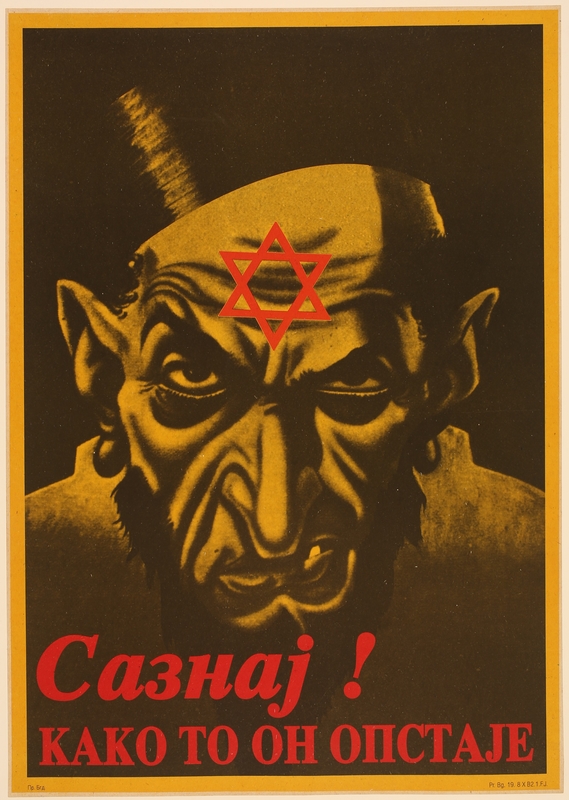 Anti-Jewish poster issued
As these portrayals intensify, disagreements can be reframed as a struggle against an enemy whose intentions are inherently evil. Opponents may be accused of deliberately seeking to destroy a country, corrupt its values, harm its people, or undermine its way of life.
Language and imagery can reinforce this transformation through comparisons to criminals, diseases, vermin, monsters, or historical embodiments of evil. This can include dehumanization, stripping the target of ordinary human qualities altogether, making contempt, disgust, or fear easier to sustain.
The ultimate effect is to change what seems like an acceptable response to the target. If opponents are understood as legitimate participants in a disagreement, compromise, negotiation, or coexistence remain possible. If they are instead understood as fundamentally evil or existentially dangerous, those same responses can appear or be intentionally portrayed as naïve or even irresponsible.
One of the central paradoxes surrounding demonization is distinguishing it from a legitimate warning about a genuine threat. Truth and demonization are not necessarily mutually exclusive. Real incidents can be selectively emphasized, generalized, stripped of context, or treated as evidence of an entire group's supposedly malignant character. A critical way to distinguish demonization lies in whether the characterization remains proportionate to the available evidence and is grounded in the specific actions, beliefs, or demonstrated intentions of the target.
The tactic can also be difficult to pin down because it exists on a continuum. While the most extreme forms of demonization are easier to recognize, sweeping declarations that an opposing group "hates the country," wants to "destroy your way of life," cannot be trusted, or poses an existential danger can be more difficult to distinguish from legitimate concerns. Such claims often attribute motives and intentions that cannot be directly observed, making the distinction especially dependent on whether those conclusions are reasonably supported by the target's words and actions. Disagreement over a policy or value, for example, does not by itself demonstrate hatred, malicious intent, or a desire to cause harm.
The distinction becomes particularly important when moving from individuals to groups. An isolated act committed by one member of a group does not necessarily establish something about the group as a whole. Demonization can erase these distinctions, treating the actions or beliefs of particular members as evidence of a shared character or intention. Similarly, legitimate concern about an extremist faction can expand into claims that a much broader population is dangerous, corrupt, or hostile. The underlying evidence may be real, while the conclusions drawn from it extend far beyond what that evidence can reasonably support.
Recognizing demonization requires looking beyond the harsh criticism to consider how an opponent or group is being portrayed. Pay close attention to messages that move beyond critiquing specific actions, beliefs, or policies to characterizing the target as fundamentally evil, dangerous, or hostile. In many cases, demonizing messages may not even mention those specifics but simply be sweeping judgments about what an opponent inherently is, rather than about what they have actually said or done.
Ask yourself: